Explore the Wonders of the Universe
Join us for stargazing events at our observatory, and visit us at Church on Sunday's at 10:30.
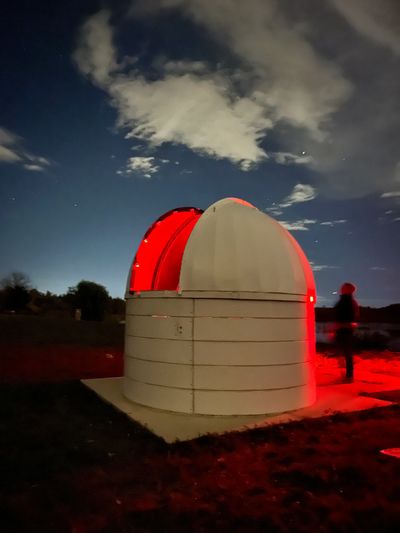

From the quiet work of observing the heavens, to the daring engineering required to reach them, astronomy has always been both a spiritual invitation and a scientific endeavor. At Valmont Observatory, we gather to look outward—toward the night sky—and to reflect on what it reveals. In this spirit, we turn our attention to a milestone in modern astronomy: the James Webb Space Telescope (JWST).
The James Webb Space Telescope was built to answer a set of questions that older instruments could not fully reach. JWST is especially powerful for studying faint, distant objects—galaxies forming early in the history of the universe—and for observing how light changes as it travels through space. Its observing strategy relies on sophisticated infrared capability, allowing it to detect heat-like signatures of astronomical objects and to “see” through regions of space where visible light is blocked. But Webb’s capabilities do not come from optics alone. They depend on an integrated system of technologies—precision structures, thermal control, detectors, and pointing systems—working together as one.
When we think of a telescope, we often imagine the view: a clear image, a spectrum of light, data that helps answer questions about stars and galaxies. Yet JWST’s most critical story is the one behind that view—the engineering effort required to make the mission succeed.
Because JWST operates far from Earth, it must be stable and reliable in conditions no ground-based instrument could replicate. The telescope had to be built to survive launch vibrations, to unfold and align with extreme precision once in space, and to keep its instruments cold enough for infrared detection. That means the mission depends on solving problems across many fabrication and alignment disciplines—problems where small errors can cascade into mission-wide consequences. In other words, the telescope’s “vision” required manufacturing discipline and end-to-end problem solving.
We are grateful that members of the Valmont Observatory Group were involved in the fabrication and engineering challenges connected to the Webb telescope. Their contributions represent a remarkable intersection of community and cosmos: people working carefully in practical engineering tasks, helping to enable a spacecraft that will study the universe on scales and timelines far beyond our daily experience.
It’s a powerful reminder that major scientific achievements are rarely the product of a single idea. They are the result of many hands, many skills, and many iterations—people tackling real-world constraints, refining measurements, and ensuring that every part can perform as designed.
For our group, this participation is not simply technical accomplishment. It is also a form of witness: an affirmation that careful workmanship, patience, and problem-solving are forms of service. Whether someone is testing components, refining fabrication processes, or supporting engineering solutions, their work helps bring Webb’s instruments to readiness—so that the mission can return data that will inspire researchers and the public for years to come.
Discover the research areas and projects conducted by the Valmont Observatory researchers. Learn about the cutting-edge technologies and methods used in our studies of exoplanets, dark matter, and cosmology. The observatory's founder worked on the Hubble and James Webb telescopes, as well as numerous other scientific missions for NASA and the European Space Agency.
In August of 2025, the VOG hosted the Boy and Girls Scouts from Boulder for a memorable event. The event kicked off with pizza and a warm welcome from our club members, who shared their passion for astronomy with the young scouts. We started with a presentation on Astronomy and science and the potential for careers and sharing the love of astronomy.
We shared stories of famous astronomers and connected the evening’s observations to the scouts’ merit badge requirements, ensuring the experience was both educational and rewarding. The Boulder Boy Scouts and Girl Scouts brought incredible energy to the event, and their enthusiasm reminded us all why we love sharing our passion for astronomy. The event was a testament to the power of community collaboration, blending the scouts’ adventurous spirit with our club’s dedication to exploring the cosmos.
Contact us for homeschooling, scouting or other educational opportunities.
Join the Valmont Observatory community and participate in our events, discussions, and collaborations. Connect with fellow astronomy enthusiasts and researchers from around the world.
Valmont Observatory Group
• Why Does a Church Have an Observatory?
• The More Science Unravels the Mysteries of the Universe, the More it is Clear God Created the Heavens and the Earth

Back in March of 2007, Dr. Stew Strickler, Mr. Ken Crowe and several members of Valmont Church were discussing the Boulder area, and the large scientific community. We stimulated the idea of building an observatory to attract more like-minded individuals to Valmont Church, and the Valmont Observatory Group was born. By August of that year, a 12” computerized telescope was donated to this effort. Over the years, we had several star parties and topical discussion events, however, without an observatory with aligned telescope and permanent structure we did not hold events as often as we wanted.
In 2024, members of Valmont Church organized, fabricated and dedicated a 10-foot diameter professional Observatory, complete with a state-of-the-art telescope mounted on a permanent pier. The Valmont Observatory Group (VOG) plans to hold multiple events for church members and the public, with our new capabilities.
In addition to astronomical events, we are planning to have guest lecture to discuss latest advances in astrophysical theories, space telescope technology as well as discussions on how faith and science are not mutually exclusive.
Astrophotography is another key objective of the VOG. Our new telescope has advanced optics and has significantly more capabilities for deep-sky photography than our previous telescopes. The VOG efforts are intended to provide knowledge entertainment, and fellowship to our members, as well as provide an outreach to the public to introduce our church to the community. We look forward to contacting home-school and private school organizations to discuss astronomy and introduce our facilities to the public.
Celestron 11" Edge HTD on Permanent Pier Mount
1/6
Trifid Nebula taken at Valmont
1/6

Helix Nebula - Taken at Valmont

M24 Star Cloud in Sagittarius

Fireworks Galaxy - 120 Minute Exposure - Taken at Valmont

Lagoon Nebula (M8) Taken At Valmont

M13- Globular Cluster in Hercules

M81 and M82 - Galaxies in Ursa Major - Taken at Valmont
We love to expand and share our interest in the heavens, so feel free drop us a note and get involved.
We use cookies to analyze website traffic and optimize your website experience. By accepting our use of cookies, your data will be aggregated with all other user data.